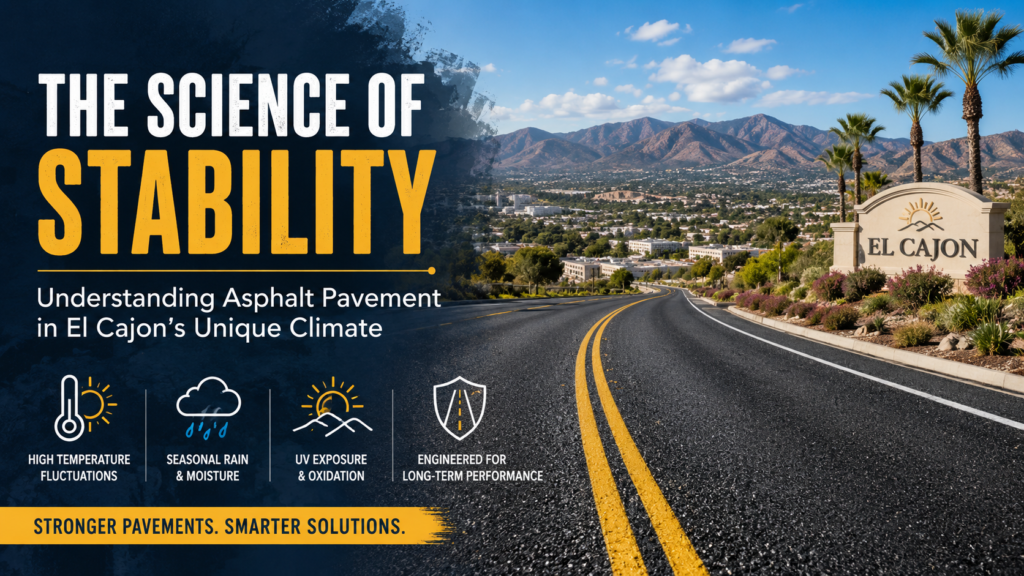
When residents and business owners in El Cajon look at their driveways or parking lots, they see a flat, black surface. However, beneath that smooth exterior lies a complex engineering marvel. As a leading Asphalt Contractor El Cajon relies on, Superior Asphalt understands that the local “Valley of the Sun” environment presents unique challenges from extreme summer heat to occasional winter rains.
Why El Cajon’s Microclimate Matters for Asphalt
El Cajon is known for its distinct microclimate. Unlike coastal San Diego, El Cajon regularly experiences temperature swings of 30-40 degrees Fahrenheit between day and night. This thermal expansion and contraction is the number one enemy of pavement.
When asphalt heats up, it expands. When it cools rapidly at night, it contracts. Over time, this “pumping action” causes the aggregates (small stones) within the asphalt to loosen. Without proper installation techniques specific to inland valleys, a driveway can become brittle within just a few years. Professional asphalt contractors understand that the mix design for El Cajon must have a higher tolerance for thermal fatigue.
The Anatomy of a Long-Lasting Driveway
Many people ask, “What goes into asphalt besides oil and rocks?” The answer is surprisingly complex. Modern asphalt is a precise blend of bitumen (a sticky, black, highly viscous liquid), crushed stone, sand, and gravel.
In El Cajon, the ideal mix uses angular aggregates rather than round ones. Angular rocks lock together like puzzle pieces, creating a more stable matrix. Round rocks tend to roll over each other under heavy weight, leading to ruts and cracks. A knowledgeable contractor will specify a mix with a higher percentage of crushed, angular particles to ensure that your driveway can handle the weight of RVs, delivery trucks, and emergency vehicles without deforming.
Common Asphalt Distresses in East County
Understanding what can go wrong helps property owners recognize when maintenance is needed. Here are the most common issues seen in El Cajon:
- Alligator Cracking: This pattern resembles the skin of a reptile. It occurs when the base layer beneath the asphalt has failed due to saturation or poor compaction. It is a structural failure, not just a surface issue.
- Linear Cracking: These are straight lines running parallel to the pavement’s edge. They usually result from temperature contraction or poorly constructed lane joints.
- Rutting: This is the formation of depressions in the wheel paths. It happens when the asphalt mix was too soft for the climate or when traffic is too heavy for the design thickness.
- Raveling: This is the progressive disintegration of the surface where aggregate particles begin to pop out. It leaves the surface looking rough and pitted, often due to a lack of sufficient binder.
The Importance of Proper Drainage
One of the most overlooked aspects of asphalt installation is drainage. El Cajon may be dry for most of the year, but when winter storms roll in from the Pacific, the area can receive intense, short-duration rainfall.
Water is asphalt’s worst enemy. If water sits beneath the pavement, it erodes the subgrade (the soil base). Without a solid, dry base, the asphalt above will crack and settle. Professional installation includes grading the land so that water flows toward catch basins or street gutters, never pooling on the asphalt surface. Contractors must also ensure that the base rock layer is at least 4-6 inches thick and properly compacted to allow water to drain away from the structure.
Sealcoating: The Protective Shield
People often ask, “Is sealcoating necessary?” The answer depends on the expected lifespan. Unsealed asphalt exposed to El Cajon’s UV rays will oxidize. The sun literally cooks the liquid binders out of the pavement, turning the surface from black to gray. Once the binder is gone, the asphalt becomes brittle and cracks.
Sealcoating acts like sunscreen for your pavement. It is a liquid emulsion (usually coal tar or asphalt-based) that fills microscopic pores and provides a sacrificial layer against UV damage, oil drips, and gasoline spills. For a residential driveway in El Cajon, sealcoating every 2-3 years can double the lifespan of the pavement.
The Role of the Base Layer
Many homeowners assume that the asphalt itself provides the strength. In reality, the asphalt is just the wearing course the decorative and protective top layer. The true strength comes from the aggregate base course (ABC) beneath.
In El Cajon’s native soils, which often contain expansive clays, the base layer is critical. Expansive clays swell when wet and shrink when dry, moving the ground significantly. A properly installed base layer of crushed rock (usually ¾-inch minus) acts as a buffer between the moving soil and the rigid asphalt. The base must be compacted to at least 95% of its maximum density to prevent future settling.
Recycled Asphalt: An Eco-Friendly Option
Many El Cajon property owners are curious about recycled materials. Recycled Asphalt Pavement (RAP) is old, removed asphalt that is crushed and ground into new aggregate. Using RAP reduces the need for mining virgin rock and lowers the carbon footprint of a project.
However, not all RAP is equal. High-quality recycling processes control the particle size and the amount of old binder remaining. When done correctly, a mix containing 20-30% RAP performs nearly identically to virgin asphalt while being more environmentally responsible. This is a popular choice for rural driveways and farm roads in the El Cajon area.
Preventative Maintenance Schedules
Ignoring small problems leads to big expenses. A single crack that is ¼ inch wide allows water to penetrate to the base. Once water is under the pavement, the damage spreads invisibly until a pothole appears.
A smart maintenance schedule includes:
- Annual Inspection: Walk the pavement looking for new vegetation in cracks, standing water, or edge raveling.
- Crack Filling (Annual): Flexible rubberized filler should be applied to any crack wider than ⅛ inch.
- Sealcoating (Every 2-3 Years): Reapply protective coating before the surface turns light gray.
- Patching (As Needed): Small damaged areas can be cut out and replaced before they grow.
Modern Paving Technology
The asphalt industry has evolved significantly. Warm Mix Asphalt (WMA) is a newer technology that allows asphalt to be mixed and laid at lower temperatures than traditional Hot Mix Asphalt (HMA). For El Cajon, WMA offers several advantages: it reduces fuel consumption, lowers emissions, and improves working conditions for crews. Additionally, WMA cools more slowly, allowing for better compaction and a denser, more water-resistant finished product.
Why Local Expertise Cannot Be Replaced
While asphalt is manufactured globally, the installation is entirely local. A contractor who understands that El Cajon’s east-facing slopes heat up faster in the morning than west-facing ones can schedule paving to ensure the optimal rolling temperature. They know which local quarries produce the best aggregates. They understand city-specific codes regarding driveway aprons and curb cuts.
Ultimately, the science of asphalt is about matching the right material to the right environment. In a climate as dynamic as El Cajon’s, guesswork is not an option. Understanding the “why” behind the pavement helps property owners make informed decisions that protect their investment for decades.